ethereum ·
DeFi Exchanges Pause Markets as Binance Hacker Swaps Stablecoins for Ethereum
Wallets linked to the suspected Binance security incident are observed on Etherscan exchanging freezable stablecoins for Ethereum on decentralized exchanges.
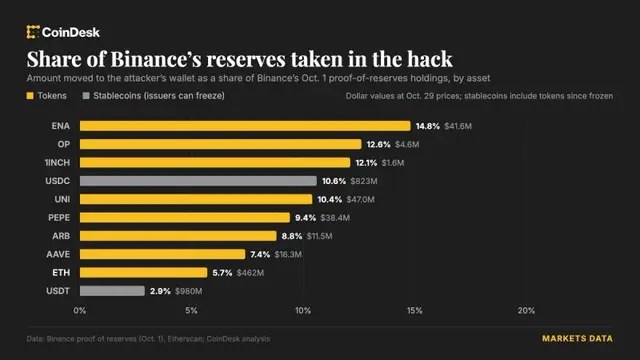
These exploiters utilized Uniswap contracts to receive tens of thousands of ETH and borrowed 19,762 ETH on Aave, against approximately $60 million in USDT. Etherscan data indicated that about 253,000 ETH, totaling roughly $570 million, remained in two wallets without any outgoing transfers as of 22:07 UTC, and ETH lacks an issuer capable of freezing it.
The attackers are reportedly using decentralized exchanges like Uniswap and Aave as exit points, swapping stablecoins whose issuers can freeze for Ethereum, which cannot be frozen.
Specific transaction data shows one relay wallet acquiring 20,940 ETH ($45.58 Million) from Uniswap’s UniswapX contract at 20:34 UTC, alongside other significant ETH inflows from Uniswap contracts into multiple wallets.
Aave, a lending application, also served as an exit mechanism. Between 20:57 and 21:01 UTC, one wallet deposited $10 million and subsequently $50 million in USDT, borrowing 3,271 ETH ($7.43 million) and later 16,491 ETH ($37.47 million) against that collateral.
In response, Aave has paused its V3 markets on the Ethereum mainnet to block new borrowing and deposits. Kamino, a Solana-based DeFi protocol, also paused its Solana and Bitcoin markets as a precautionary measure, confirming it is currently unaffected by the Binance situation.
Furthermore, Ripple has frozen about $200 million in RLUSD, as stated by Binance co-CEO Yi He, complementing the over $2 billion already frozen across USDT and USDC by different stablecoin providers.
Stablecoin issuers Tether and Circle acted swiftly to blacklist the addresses associated with the suspected attacker to freeze some funds, leveraging their centralized control over their respective tokens.
These actions by centralized issuers contrast with the nature of ETH, which has no issuer, meaning any conversion to ETH before a freeze is implemented is beyond the issuers' reach.
The actions taken by regulators and exchanges highlight the differing jurisdictional control over assets, where centralized tokens can be halted, while decentralized assets remain liquid unless specific protocols intervene.
Why it matters
This incident highlights the vulnerability of cross-platform asset movement during a major exchange breach. Regulatory bodies and exchanges are now reacting by pausing services to prevent further contagion across DeFi protocols. Investors should monitor how decentralized finance platforms respond to centralized exchange security failures.